

Key points
- Microsoft 365 leads by paid seats with over 450 million, while Google Workspace hosts more domains in the US and in most of the APAC markets we measured.
- The answer to who leads depends on the metric: seats, domains, sending records and tracked companies give different winners, so any market share claim needs its method stated.
- Credible Microsoft 365 alternatives are mostly regional: Alibaba and Tencent in China, IONOS and OVH in Germany and France, Zoho in India, LINE WORKS in Japan.
- Mail is the cheap part of a switch. Identity, Teams telephony, SharePoint data and automation decide what an exit really costs.
Microsoft reported over 450 million paid commercial Microsoft 365 seats in January 2026 [1]. Google does not publish a seat count; a Google executive put Workspace at more than 11 million paid users in May 2025, with the unit stated inconsistently in the same interview [3]. Boards asking for Microsoft 365 alternatives usually get a price list. The better question is who runs business email in each market, and what leaving costs.
Our reading of the data is simple. Microsoft has by far the largest paid seat base, Google leads most domain counts outside Europe, and real alternatives only have scale where local language, regulation or a local hoster gives them an advantage.
Microsoft 365 market share depends on what you count
There is no neutral market share figure. Only Microsoft reports seats. Domain studies count mail exchanger (MX) records, which gives a small company the same weight as a group with 100,000 users. Technographic vendors count tracked companies with their own detection rules.
| Metric (unit) | Microsoft 365 | Google Workspace | Named others | Source, date |
|---|---|---|---|---|
| Paid commercial seats | over 450 million | no public data | no public data | Microsoft via [1], Jan 2026 |
| Paid users or customers (unit unclear) | n/a | more than 11 million | no public data | [3], May 2025 |
| Mailbox provider, Tranco top 1 million domains | 16.8% | 21.8% | Proofpoint gateway 1.9% | [4], Jul 2026 |
| Mailbox provider, 422 million mail-capable domains | 9.5% | 13.6% | Zoho 1.3% | [5], Aug 2026 |
| Declared sender in SPF, 3.1 million Tranco domains | 19.6% | 13.6% | Zoho 1.6% | [6], Mar 2026 |
| Share of tracked companies, office productivity (Enlyft) | 31.5% | 30.9% | no public data | [8], accessed Oct 2026 |
Microsoft leads where declared senders are counted and, narrowly, in tracked companies. Google leads where mailbox domains are counted. The domain studies also understate Microsoft, because tenants behind a Proofpoint or Mimecast gateway do not show Microsoft in their MX record [5]. 6sense reports Google Workspace at 73.4% of its Office Suites category [7], but its category definition differs, so we leave it out.
The US and APAC split differently than Europe
For a regional view we use a single source and a single method: BuiltWith detections of email hosting per country, as of October 5, 2026 [9]. The shares below are calculated by us. Microsoft 365, Google Workspace and 7 named alternatives (Zoho, Tencent, Alibaba Mail, Yandex, IONOS, Proton, OVH) form 100%. Registrar-bundled mail such as GoDaddy is excluded. It counts websites, not users.
| Market | Microsoft 365 | Google Workspace | 7 named alternatives | Largest alternative |
|---|---|---|---|---|
| USA | 29.5% | 45.8% | 24.7% | IONOS |
| Canada | 46.7% | 43.2% | 10.1% | IONOS |
| Australia | 57.1% | 38.4% | 4.5% | Zoho |
| Singapore | 37.7% | 52.3% | 10.0% | Zoho |
| Malaysia | 32.5% | 55.2% | 12.3% | Zoho |
| Thailand | 25.2% | 67.3% | 7.5% | Zoho |
| Vietnam | 27.2% | 55.1% | 17.6% | Zoho |
| Japan | 30.4% | 67.1% | 2.5% | Zoho |
| India | 16.9% | 58.4% | 24.6% | Zoho |
| South Korea | 16.8% | 79.4% | 3.8% | Zoho |
| China | 6.1% | 7.1% | 86.8% | Alibaba Mail |
| Germany | 26.0% | 7.2% | 66.8% | IONOS |
| France | 13.3% | 9.1% | 77.5% | OVH |
| Netherlands | 66.0% | 28.0% | 6.0% | Zoho |
| .eu domains | 18.0% | 11.9% | 70.1% | IONOS |
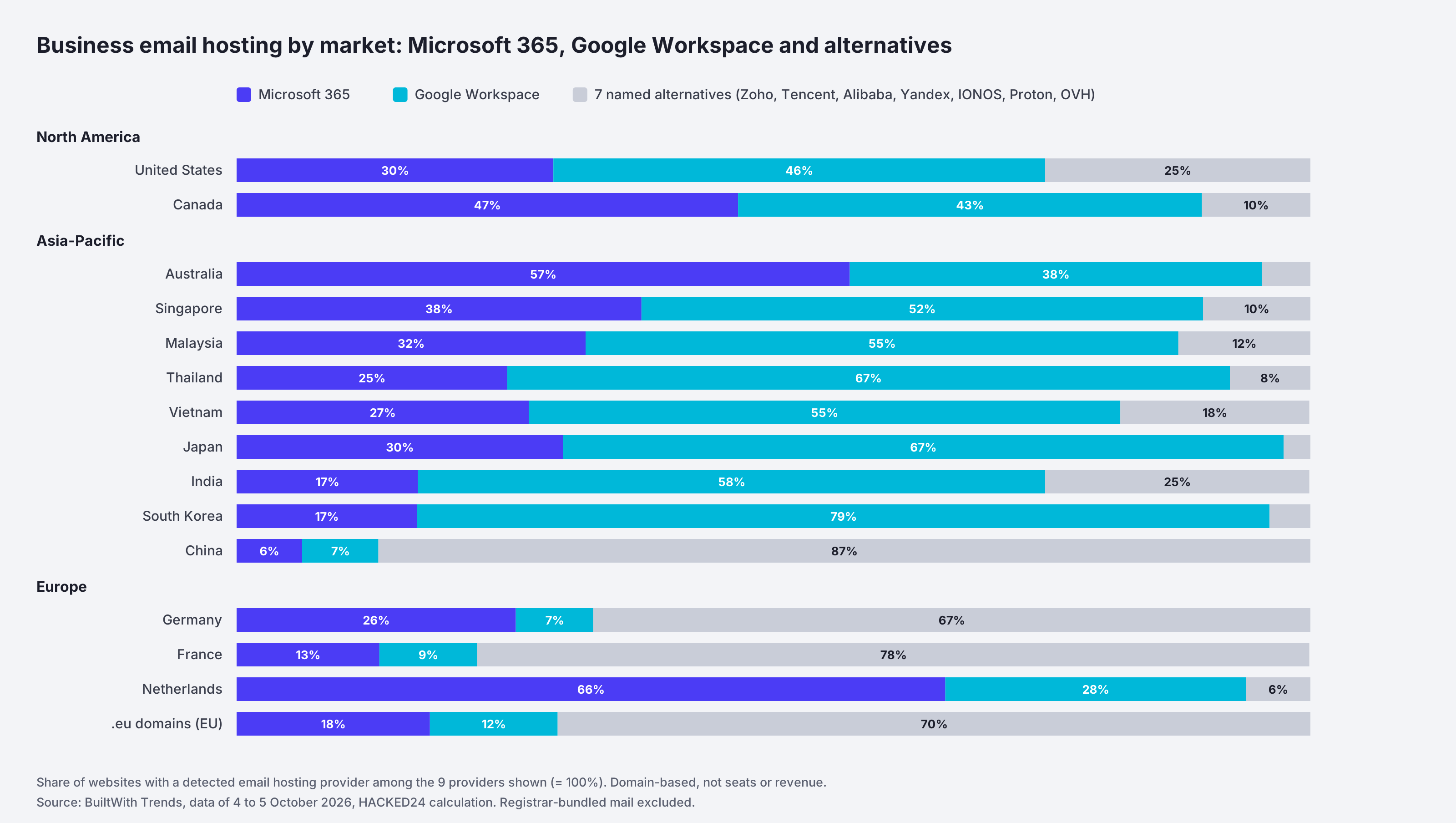
Google leads the US count and every Southeast Asian market in the set, with Japan and South Korea at 67.1% and 79.4%. Australia and Canada lean toward Microsoft. China is a separate market: Alibaba and Tencent account for 86.8% of the count, and Microsoft 365 there is operated by 21Vianet, not by Microsoft, with a reduced feature set [11]. A 2021 study found Tencent and Yandex serving almost only their home country domains [10].
Germany and France are the only large markets where a local hoster beats both US vendors on this count: IONOS in Germany, OVH in France. Most of those domains belong to small businesses, so this says little about enterprise seats. No vendor publishes seat data per country.
Real Microsoft 365 alternatives are regional, not global
Outside Google, no alternative has published global seat numbers that compare with Microsoft. The scale that exists is regional. Alibaba states that more than 7.83 million organisations use AI features on DingTalk as of March 31, 2026 [12]. LINE WORKS reported 590,000 corporate clients and 5.8 million users in Japan [13]. Zoho is the strongest alternative in India on the BuiltWith count. We found no current, primary figures for Lark, WeCom or Naver Works in Korea, so we do not quote any.
In Europe the movement is political and comes from the public sector. Schleswig-Holstein finished moving more than 40,000 mailboxes from Exchange and Outlook to Open-Xchange and Thunderbird in October 2025, after reported downtime during the cutover [14]. The German federal administration ran 8,475 openDesk licences in production as of April 2026 [15]. The International Criminal Court confirmed its move to openDesk on October 31, 2025, after US sanctions against its prosecutor [16]. Denmark's digital ministry announced a switch to LibreOffice in mid 2025 [17]. These are political sovereignty decisions, not cost decisions.
Mail is cheap to move, identity is not
Both main vendors are raising prices. From July 1, 2026, Microsoft 365 E3 rose from $36 to $39 per user and month, E5 from $57 to $60 and F3 from $8 to $10 [18]. Google raised Workspace Business Standard from $12 to $14 on annual plans in 2025 and justified it with Gemini [19]. Both now bundle AI into the base price, which makes the seat price harder to compare and to cut.
In a typical environment with 3,000 users, moving mailboxes is a known project. The expensive part is everything tied to Entra ID: conditional access, device compliance through Intune, single sign-on for hundreds of SaaS apps, and the service principals behind Power Automate flows. Add Teams Phone numbers and call queues, SharePoint sites with broken permission inheritance and years of OneDrive data. With over 30 million paid Copilot seats [2], more organisations also carry prompts, agents and Purview policies that have no equivalent on the other side.
An alternative makes sense where the constraint is legal or political, where most users are frontline workers with simple mail needs, or where a group is already mostly on Google. It rarely makes sense as a pure cost move for a Microsoft-centred enterprise. The licence saving is visible on day 1; the cost of rebuilding identity, telephony and compliance shows up over 18 months.
What to do now
- CIO: Map every dependency on Entra ID, Teams Phone, SharePoint and Power Platform before anyone prices an alternative. This list, not the mailbox count, sets the exit cost.
- CFO: Model the July 2026 price change at your next renewal and price an alternative over 3 years including migration, parallel running and retraining.
- CISO: Decide which data needs a jurisdictional exit option, and test that option for that data only, for example a sovereign mail and file platform for a single business unit.
- Procurement: Ask any vendor for market share claims with the metric named. A share of domains is not a share of seats.
- IT Operations: Keep identity portable: standard protocols for SSO, documented app registrations and exportable conditional access policies.
We look at this question with read access to licences, identity configuration and usage first, then put an exit price next to the renewal price, on the client's own numbers. That is part of our Executive IT & AI Review and our Microsoft Platform Services. How to judge the Copilot part of the bill is covered in Renew Microsoft 365 Copilot seats on usage data, the regional cost picture in APAC AI spending.
Note
As of October 8, 2026. Regional shares are our calculation from BuiltWith detection counts and measure websites, not users or revenue. Vendor figures are as reported and not independently audited. Prices are US list prices.
Sources
- Microsoft 365 Exceeds 450 Million Commercial Paid Seats, Office 365 for IT Pros, January 30, 2026
- Azure Tops $100 Billion As Microsoft Reports FY26 Q4 Results, Office 365 for IT Pros, July 30, 2026
- Google Workspace added 1 mn paid enterprise users in 2024, Business Standard, May 16, 2025
- Email in the Tranco Top-1M, Internet Society Pulse, August 25, 2026
- MX Flux, DomainsProject, August 20, 2026
- Email Provider Market Share 2026, DMARCguard, July 2, 2026
- Google Workspace market share, Office Suites category, 6sense, accessed October 8, 2026
- Microsoft Office 365 market share, Enlyft, accessed October 8, 2026
- Email Hosting Providers by country, BuiltWith Trends, data as of October 5, 2026
- Who’s Got Your Mail?, Liu et al., ACM IMC 2021
- Microsoft 365 operated by 21Vianet, Microsoft Learn, accessed October 8, 2026
- DingTalk, Alibaba Group, accessed October 8, 2026
- Naver focuses on enterprise messaging in Japan, Korea JoongAng Daily, July 12, 2025
- Schleswig-Holstein e-mail converted to open source, heise online, October 2025
- Digitales und Staatsmodernisierung, Antwort, hib 350/2026, Deutscher Bundestag, April 27, 2026
- Justice Recoded, EJIL:Talk, November 2025
- Denmark’s Digital Ministry drops Microsoft, Computing, July 9, 2025
- Microsoft to Increase Office Suite Prices Starting July 2026, Directions on Microsoft, December 4, 2025
- Google Workspace price increase 2025, 9to5Google, January 15, 2025